Canada and EU Launch “Alliance for the Future” Open to Like‑Minded Nations
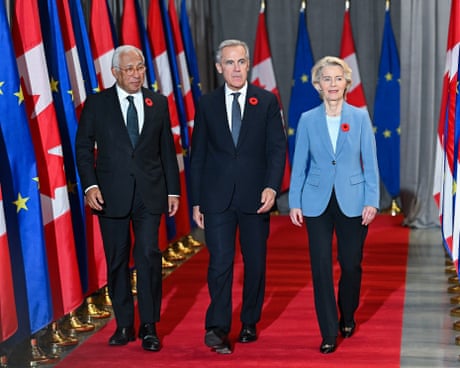
Canada and the European Union unveiled a broad partnership called the Alliance for the Future, inviting other countries to join.
Montreal Summit Sets the Stage
At a two‑day gathering in Montreal, Canadian Prime Minister Mark Carney and European Commission President Ursula von der Leyen introduced the Alliance for the Future, a coalition of “like‑minded” nations that they said would act as a “protective canopy under which our citizens can thrive.”
The pair described the partnership as the “deepest possible partnership between Canada and the 27‑member bloc,” with the potential to deliver “unprecedented stability and opportunity.”
Why the Alliance?
Carney framed the need for the alliance by noting that “our societies have been shaken by new storms,” citing the climate emergency, “erosion of democratic norms,” and the weaponisation of trade.
Von der Leyen added that when “trade becomes a tool of economic pressure, it’s the families that pay the price, from the supermarket shelf to the cost of a new car,” pointing to the recent turn of energy, critical minerals and semiconductor suppliers into instruments of pressure.
Financial Commitments and Market Integration
Canada agreed to contribute to a €90 billion support loan for Ukraine as part of the summit’s outcomes.
Both sides said future talks would aim at a “more integrated market worth tens of billions of dollars,” with the goal of reducing trade and travel restrictions and expanding educational opportunities.
Technology Cooperation
Carney highlighted a planned merger between Canadian AI firm Cohere Inc and Germany’s Aleph Alpha GmbH. The new entity will have dual headquarters in Berlin and Toronto, and the Canadian government announced a stake in Cohere of up to C$1.6 billion.
He warned that Canada is not waiting for the future of AI to be decided somewhere else by those we don’t know, or by whom we don’t trust.
In parallel, Brussels and Ottawa signed an agreement to give Canada access to Europe’s supercomputing network, allowing Canadian researchers to train AI models on European machines.
Geopolitical Context
The announcement comes as Canada seeks alternatives to an over‑reliance on the United States for defence and technology, a concern amplified after Elon Musk throttled Starlink and Starshield services over Ukraine in mid‑October, disrupting Ukrainian military operations.
Musk, a dual Canadian citizen and critic of Canada’s Liberal government, has advocated for provincial separation, adding a political dimension to Canada’s technology strategy.
Future of the Alliance
Both leaders suggested the alliance could evolve into an “associate member” status for Canada, a concept von der Leyen called “uncharted territory” but one that could be shaped together with “ambition, trust, and creativity.”
Carney summed up the vision with “more competition, more choice,” implying that the alliance will help build certainty around supply chains and enable the partners to “withstand shocks, together.”
The Alliance for the Future therefore aims to combine climate resilience, democratic solidarity, and economic integration while keeping the door open for additional like‑minded countries to join.






