Hubble Finds Dwarf Galaxies Lose Most of Their Oxygen to Galactic Winds
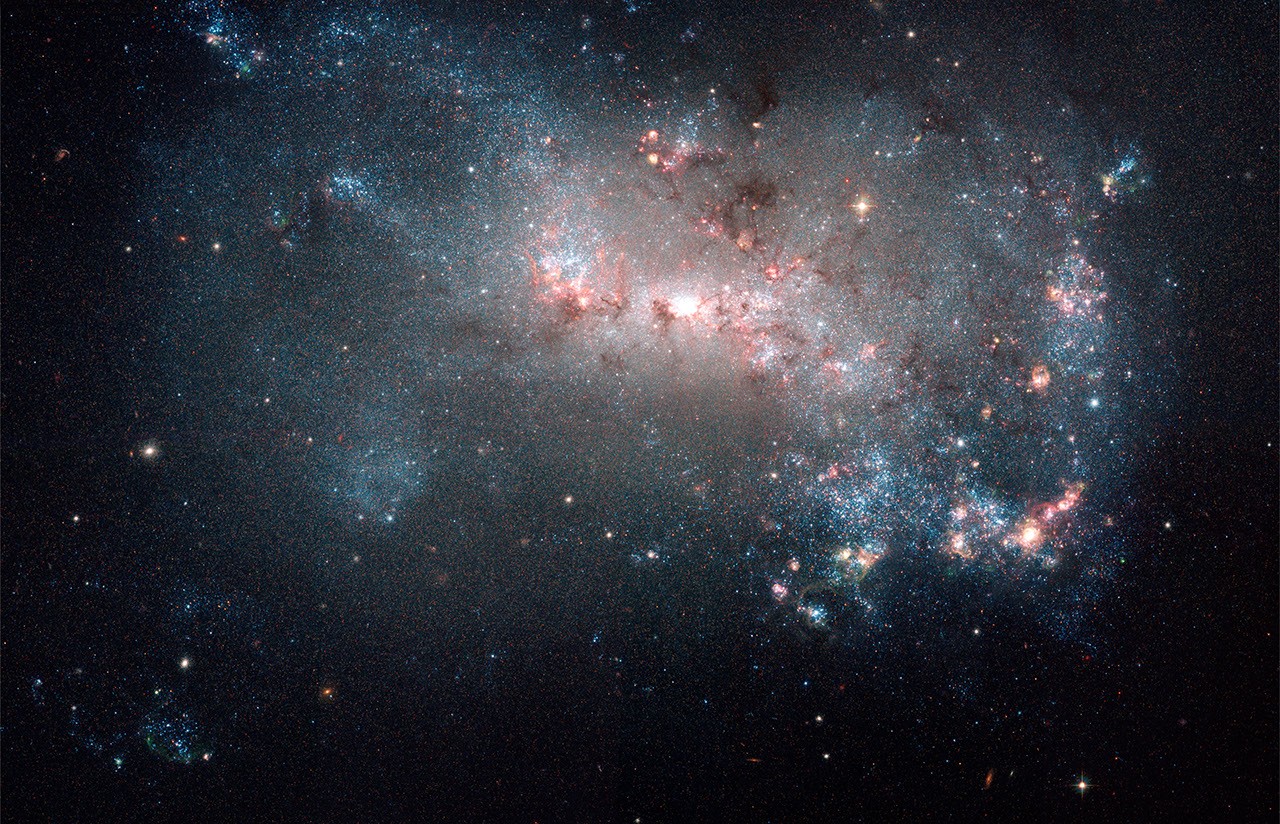
A new Hubble‑based study shows that low‑mass galaxies retain only a tiny fraction of the oxygen their stars produce.
Hubble data reveal an oxygen shortfall in dwarf galaxies
In a paper released Monday in The Astrophysical Journal, a team using archival Hubble imaging examined 37 dwarf galaxies within the local universe. These systems, ranging from a few thousand to hundreds of millions of stars, were expected—according to simulations—to contain far more oxygen than the observations show.
Supernova‑driven winds as the likely culprit
Co‑investigator Grace Telford, an assistant professor at the University of Utah, explained that “oxygen is produced by stars, which are inside of galaxies… the oxygen must have been ejected.” She added that massive stars and supernova explosions provide the energy needed to push material out of the host galaxies and into intergalactic space.
The study concludes that galactic winds are more effective at stripping oxygen from low‑mass galaxies than current theoretical models anticipate, leaving these dwarfs with only a small fraction of the element they generate.
Why focus on oxygen?
Principal investigator Kristen Wingfield McQuinn of the GLOW project noted that oxygen is the most abundant element after hydrogen and helium, is relatively easy to detect, and has a well‑understood production pathway. “It’s really for practical reasons that we’ve chosen oxygen,” she said, emphasizing its value as a tracer for the distribution of heavier elements across stars, gas, dust, and the intergalactic medium.
Methodology and complementary data
The GLOW team combined Hubble’s optical imaging—used to resolve individual stars and reconstruct star‑formation histories—with infrared data from the retired Spitzer Space Telescope and radio observations from the Very Large Array and the Australian Telescope Compact Array. The selected dwarfs fall within a mass range where theory predicts an increasing fraction of oxygen should be expelled by supernovae.
Because Hubble can resolve stars only in relatively nearby dwarfs, the sample is limited to galaxies close enough for such detailed analysis, unlike the majority of known dwarf systems that lie beyond Hubble’s resolving power.
Context within previous research
A 2014 study of Milky Way‑like, star‑forming galaxies found that a large share of their oxygen resides in the circumgalactic medium—the diffuse halo of gas surrounding galaxies. The GLOW project extends this inquiry to lower‑mass galaxies, exploring whether the missing oxygen ends up in similar halos or is completely ejected beyond the galaxies’ immediate surroundings.
Future directions
McQuinn has secured approval to employ the Nancy Grace Roman Space Telescope to locate even fainter, lower‑mass dwarf galaxies across a broad sky area. Once identified, she plans to use Hubble and the James Webb Space Telescope for deeper stellar observations, aiming to reconstruct detailed star‑formation histories.
Telford intends to use Hubble to zoom in on the massive stars that synthesize oxygen in the GLOW targets, seeking to characterize how these stars differ in dwarf environments.
Hubble’s enduring role
Now in its third decade, the Hubble Space Telescope continues to deliver discoveries that reshape fundamental astrophysical understanding. Operated jointly by NASA and ESA, with mission support from NASA’s Goddard Space Flight Center, Lockheed Martin Space, and the Space Telescope Science Institute, Hubble remains a cornerstone of modern space‑based astronomy.