New Fossil Crocodile from Sphinx‑Era Rocks Sheds Light on Ancient Marine Gavials
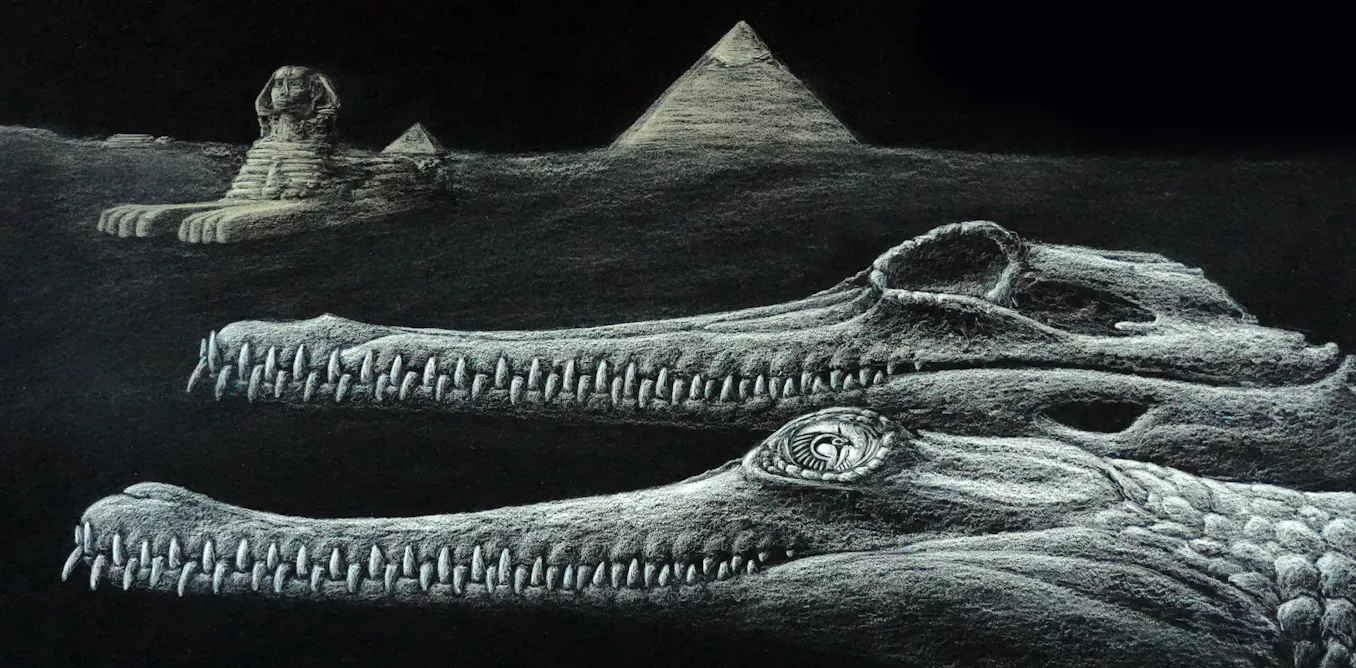
A 45‑million‑year‑old crocodile skull from the Mokattam Formation reveals how long‑snouted gavials once roamed the seas.
Discovery of a New Gavial Species
My colleagues and I have identified a new extinct crocodile species from a fossil recovered in the limestone of Egypt’s Mokattam Formation. The rock, which formed about 45 million years ago in a shallow marine setting, also supplied the stone used to carve the Great Sphinx of Giza.
Originally described in 1927 as a member of Tomistoma because of its superficial similarity to the living Indian gharial, the specimen includes a nearly complete skull. Using CT scanning, we detected several distinct features—most notably raised rims around the eye sockets that are absent in modern Tomistoma schlegelii. These differences led us to name the new species Herugavialis cairensis, after the Egyptian falcon‑headed god Heru (Horus), whose missing nose mirrors the fossil’s missing snout tip.
Implications for Gavial Evolution and Distribution
Today only two long‑snouted gavial species exist—Gavialis gangeticus and Tomistoma schlegelii—both confined to freshwater habitats in the Indian subcontinent and Southeast Asia. The fossil record, however, stretches back 80 million years and includes more than 40 known species that once inhabited a global range.
Our findings add to a growing body of work that uses skeletal anatomy and CT‑derived brain and sensory data to differentiate extinct gavial species and infer their biology. In particular, the thickened outer wall of the inner ear observed in some marine‑adapted crocodile relatives matches similar structures we see in certain fossil gavials, indicating a capacity for coping with higher pressures in deeper water.
Historical Context of the Fossils
Many African and European gavial fossils were first reported in the late 19th and early 20th centuries and were often assigned to Tomistoma. Subsequent research, including our own, has shown that several of these specimens belong to distinct lineages, prompting new taxonomic names. Yet a number of these historically described species remain understudied.
Our team, led by former PhD student Paul Burke now at the Swedish Museum of Natural History, re‑examined the Mokattam specimen alongside colleagues from Egypt and Germany. The study highlights how modern imaging can overturn century‑old classifications.
Why Gavials Vanished from the Mediterranean
During much of the last 80 million years, northern Africa and southern Europe supported a rich diversity of gavials and other crocodiles in the shallow seas that covered the Mediterranean region. Some of these species likely crossed oceans, a capability lost in today’s freshwater‑only gavials.
Approximately 6 million years ago, crocodiles disappeared from the Mediterranean. This timing coincides with the Messinian salinity crisis, when the sea became isolated from the Atlantic and largely evaporated, leaving an increasingly hypersaline environment. Even crocodiles capable of tolerating saltwater would have found the conditions intolerable, leading to their regional extinction.
The legacy of that event persists: the modern Mediterranean Sea remains saltier than the open oceans, and crocodiles are absent from the basin entirely.
Broader Significance
By clarifying the marine adaptations of extinct gavials, the study helps explain how a group now restricted to rivers once achieved a cosmopolitan distribution. It also underscores the impact of dramatic climatic and sea‑level changes on reptile evolution—a reminder that today’s endangered gavials are the remnants of a once globally diverse lineage.